
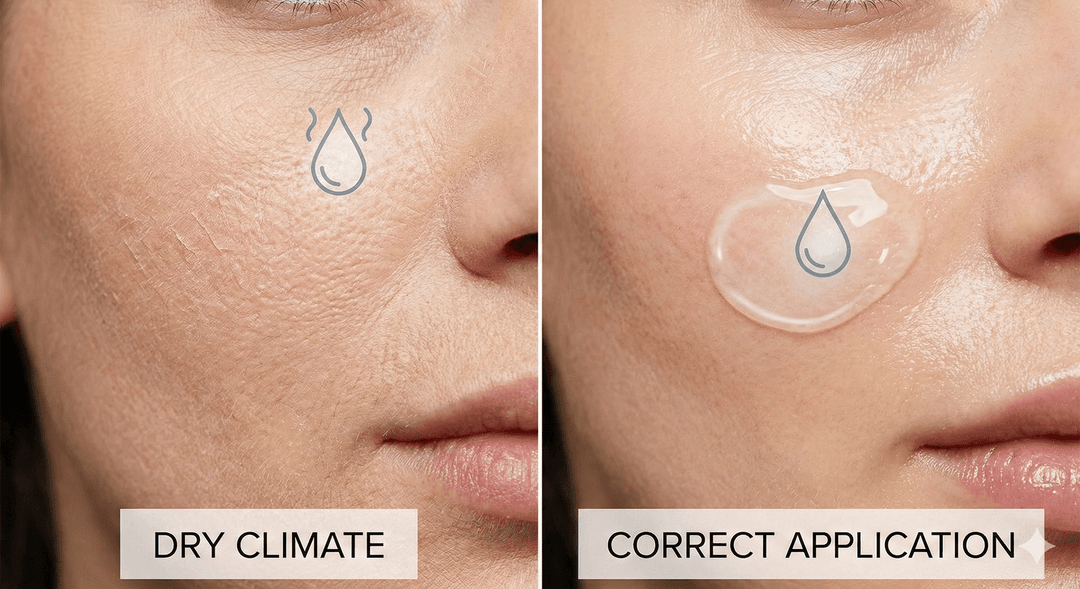
If you bought a Hyaluronic Acid (HA) serum expecting the "glass skin" promised by influencers, only to find your face feeling tighter than before you applied it, you are not crazy. And you are not alone.
The most common complaint about Hyaluronic Acid on forums like Reddit’s r/SkincareAddiction isn’t that it doesn’t work; it’s that it makes dryness worse.
Marketing sells HA as a magic moisture generator. It is not. It is a humectant. The difference between those two things is why your skin feels like dried glue.
Think of Hyaluronic Acid as a microscopic sponge. It is famous for its ability to hold up to 1,000 times its weight in water.
But a sponge doesn't create water; it just holds onto whatever water it can find nearby.
This is where it goes wrong: Because HA must satisfy its need for water, it will pull moisture from the nearest available source: the deeper layers of your own skin.
It drags that deep hydration up to the surface. If you don't immediately seal it in, that moisture evaporates into the dry air. You are left with less hydration than when you started, and a layer of tacky serum sitting on top of tight skin.
The problem isn't the ingredient; it's the application method. Most people apply HA serum to a dry face and walk away. This is a guarantee for dehydration.
To make Hyaluronic Acid work, you must provide the water for the sponge, and then you must trap it there.
1. The Damp Skin Rule Never apply HA to dry skin. Your face must be slightly wet (not dripping, but damp) from cleansing or a facial mist. This gives the HA immediate moisture to grab onto, so it doesn’t have to steal it from your skin layers.
2. The Occlusive Seal HA is a hydrator, not a moisturizer. It adds water, but it cannot lock it in. You must follow your HA serum immediately with a moisturizer that contains occlusive ingredients (like shea butter, squalane, or silicones). This creates a physical barrier that stops the water the HA has collected from evaporating.
If you live in an extremely arid climate, or if your skin barrier is severely damaged, Hyaluronic Acid might just be too finicky for your routine.
Reddit consensus suggests that for very dry environments, Glycerin is often a superior, more reliable humectant that is less likely to cause the "drying effect."
Now that you have mastered the application, you need the right formula. Not all Hyaluronic Acid serums are created equal—some leave a sticky residue that pills under makeup, while others sink in like water. If you want to skip the trial-and-error and see which bottles Reddit users actually repurchase (and which ones they regret), check out
Wash your face as usual. Gently pat it with a towel, but leave the skin feeling slightly wet to the touch. Do not let it dry completely.
While your skin is still moist, dispense 2-3 drops of Hyaluronic Acid serum into your palms and press it gently into your face and neck
Do not wait for the serum to dry down completely. While it is still slightly tacky, apply a cream or lotion-based moisturizer right on top to lock the hydration in.