
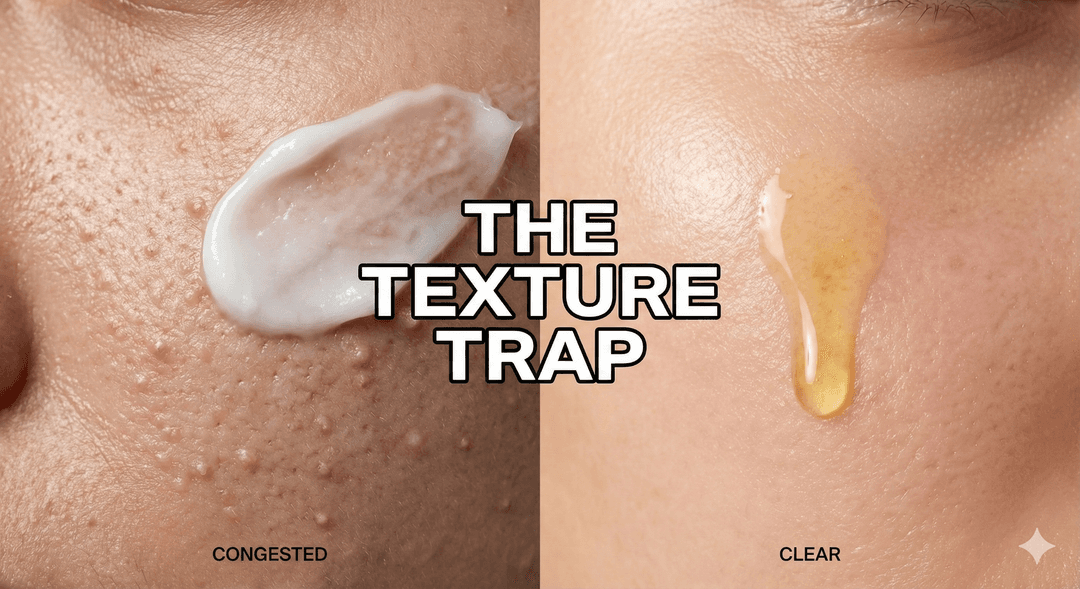
You don’t have "acne" in the traditional sense. You don’t have angry red cysts or whiteheads that pop easily. Instead, when you stand under the harsh fluorescent lights of a bathroom mirror and tilt your head just right, you see them.
Hundreds of tiny, flesh-colored bumps.
They make your skin look like a pebbled road rather than a sheet of glass. Makeup doesn't hide them; it accentuates them. These are Closed Comedones (CCs), and they are the arch-nemesis of the skincare enthusiast.
If you have been aggressively treating these with acids and retinoids but seeing no change, the call is coming from inside the house. The problem isn't that you aren't exfoliating enough; it's likely that your "barrier repair" moisturizer is clogging you faster than you can unclog yourself.
In this report, we break down the chemistry of the clog and present the "Reddit Consensus" solution: The migration from Waxes to Liquids.
Why does a moisturizer labeled "Non-Comedogenic" cause comedones?
The term "Non-Comedogenic" is unregulated marketing. A product can claim this title even if it contains ingredients that trigger your specific skin. For the Reddit community, the most common culprit is not oil, but the Fatty Alcohol Matrix.
The "Waxy" Film
Heavy creams—specifically CeraVe — rely on a specific combination of ingredients to create that thick, luxurious texture: Cetearyl Alcohol and Ceteareth-20.
While excellent for eczema and dry body skin, this specific pairing creates a "waxy" matrix over the pore. If your sebum production is high, your natural oil gets trapped under this wax, hardening into a keratin plug (the closed comedone).
The result is that you feel moisturized, but your skin texture gets rougher by the day.To solve this, you need hydration (water and ceramides) without the heavy lipid matrix (wax). You need to move down the "Occlusion Scale."
If you are prone to texture, you need products that support the barrier without suffocating it. We have analyzed the feedback on our platform to identify the best alternatives for clog-prone skin.
If CeraVe is a heavy winter coat, Stratia Lipid Gold is like a super breathable fabric in comparison. It contains the same "golden ratio" of ceramides, cholesterol, and fatty acids needed for barrier repair, but it delivers them in a lightweight, liquid emulsion.
The difference here is that it uses Sea Buckthorn Oil (which gives it the yellow color) rather than heavy petroleum or waxy thickeners. It absorbs instantly, leaving no film to trap bacteria.
Do not confuse this with the "Vanicream in the Tub." The Vanicream Daily Facial Moisturizer is a completely different formula.
This works because it swaps the heavy petrolatum found in the tub version for Squalane and Hyaluronic Acid. Squalane is a skin-identical oil that is highly unlikely to clog pores compared to the heavy waxes found in other drugstore brands.
It is the perfect middle ground for someone who finds gels too light but creams too heavy.
For those with extremely oily skin who just want the bumps to stop, Clinique Dramatically Different (specifically the Gel version) remains a consensus favorite.
It is essentially void of the fatty alcohols that cause the "CeraVe Clog." It provides basic hydration using silicones, which sit on top of the skin in a breathable mesh rather than sinking in and plugging the pore.
If you are currently fighting closed comedones, you should temporarily bench the heavy hitters. These products are incredible for dry skin or eczema, but they are often too occlusive for texture-prone faces.
Switching your moisturizer is Step 1. But those closed comedones won't disappear overnight. They are hardened plugs of oil deep in the pore.
The Strategy:
If your skin feels rough but looks oily, stop trying to suffocate it with heavy "repair" creams. Listen to the data: lighter is usually better for texture. By removing the waxy film, you allow your pores to breathe and your texture to smooth out.
Check out our full face moisturizer rankings to see where your current moisturizer falls on the list.
Stop using any heavy cream containing Cetearyl Alcohol + Ceteareth-20 (like CeraVe in the tub) immediately.
Switch to a lightweight barrier support serum or lotion. Stratia Lipid Gold is the recommended swap for repair; Vanicream Daily Facial is the recommended swap for basic maintenance.
Apply a gentle AHA (mandelic or lactic acid) 3 nights a week to dissolve the surface skin cells trapping the oil.