
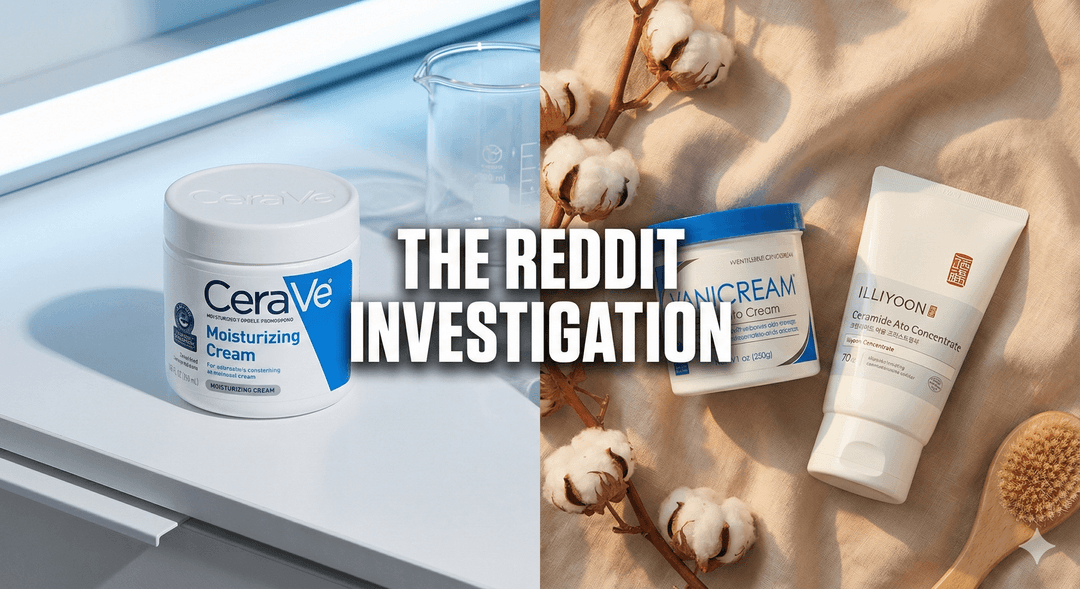
In the vast, codified aisles of the skincare library, CeraVe sits on the "Reference" shelf. It is the gold standard, the default recommendation, the dermatological darling. With its clinical white packaging and the reassuring seal of the National Eczema Association, it promises a simple truth: I am safe. I will repair you.
Yet, if you dig into the archives of user experience—specifically the 2.5 million members of r/SkincareAddiction—a different narrative emerges. It is a narrative of burning, stinging, and deep, painful cysts.
You are likely reading this because you are confused. You bought the CeraVe Moisturizing Cream (affectionately known as "The Tub") or the Hydrating Cleanser to fix your damaged moisture barrier. But instead of relief, you felt a sensation users describe as "lava." Or perhaps, a week later, you noticed a cluster of flesh-colored bumps on your cheek where you never usually break out. You asked your dermatologist, and they told you it was impossible—CeraVe is non-comedogenic. You asked the internet, and the influencers told you to "trust the ceramides."
But your skin is telling you something else.
This report is a forensic investigation into the "CeraVe Paradox." We are not here to bash a brand that works for millions. We are here to validate the experience of the thousands for whom it does not. By synthesizing chemical analysis with anecdotal consensus from the world's largest skincare forums, we will uncover why the Holy Grail might be poisoning your well.
We investigate three primary suspects:
The Engine: MVE Technology and the theory of continuous irritation.
The Vehicle: The "Fatty Alcohol" synergy that creates a comedogenic film.
The Passengers: Preservatives and Niacinamide hidden in the mix.
To understand why CeraVe burns, we must first understand its engine. CeraVe’s claim to fame is not just its ingredients (Ceramides 1, 3, and 6-II), but how those ingredients are delivered. This is MVE Technology (MultiVesicular Emulsion).
The Mechanism of MVE
Standard moisturizers are simple emulsions: oil droplets suspended in water (or vice versa). When you apply them, they burst, delivering their hydration in one go.
MVE is different. Imagine an onion. MVE consists of concentric spheres of oil and water phases. As the product sits on your skin, these layers slowly peel away, dissolving over time. This allows for a "controlled release" of moisturizing ingredients over a 24-hour period.5
The Theory: By dripping hydration into the skin all day, the barrier is constantly supported.
The Reality for Sensitive Skin: For a subset of users, this mechanism appears to be the primary source of irritation.
The Reddit Consensus: "It Never Stops Working"
Deep-dive analysis of user reports reveals a specific pattern to the "CeraVe Burn." It is rarely an allergic itch; it is a profound, stinging heat.
User Evidence:
"I noticed after giving it a good 2 months that it really burns my skin. Especially if I exfoliate or use my Clarisonic, it BURRRNS." — User report from r/SkincareAddiction.
This "burn" is frequently cited as the reason users abandon the brand, often migrating to Vanicream, which utilizes a standard, non-time-release emulsion.
If the "Burn" is the complaint of the sensitive user, the "Clog" is the nightmare of the acne-prone.
A massive volume of data points to CeraVe Moisturizing Cream causing Closed Comedones (CCs). These are not inflamed, red pimples (pustules). They are non-inflammatory keratin plugs—small, hard bumps that make the skin look pebbly under harsh lighting.
The Chemistry of the Clog
CeraVe in the Tub is famous for being "Non-Comedogenic." So why does it clog so many people? The answer likely lies in the Emulsifying System.
The cream relies on a specific pairing:
The Synergistic Effect:
Individually, these ingredients are considered safe. Cetearyl Alcohol is rated approx. 2/5 on comedogenicity scales. However, older dermatological research (and persistent Reddit "skincare detective" work) suggests that the combination of Cetearyl Alcohol and Ceteareth-20 creates a film that is highly occlusive in a way that traps sebum inside the pore.11
"The tub has the cetearyl alcohol + ceteareth-20 combo... I am clog-prone and it worsened my skin's appearance." — User Report.11
The Lifecycle of a CeraVe Breakout
According to user logs, the breakout timeline is distinct:
While the "Tub" is free of Niacinamide, the PM Facial Moisturizing Lotion and the AM Lotion are loaded with it.
The Niacinamide Overload
Niacinamide (Vitamin B3) is a superstar ingredient for barrier repair. However, CeraVe PM contains a significant concentration (estimated around 4%).
Since many users are already getting Niacinamide from their serums (e.g., The Ordinary 10% Niacinamide) and toners, the result is what we see as "Niacinamide Flushing". High concentrations of B3 causing vasodilation—a widening of the blood vessels. Users report their face turning hot and red, mimicking a rosacea flare.
"I get painful red swelling on my nose when I use niacinamide... Like a bee sting." — User Report.21
The Phenoxyethanol Sting
For the Baby line (which is often recommended as an alternative), the preservative Phenoxyethanol becomes the suspect. While generally safer than parabens, Phenoxyethanol can cause a specific "warming" sensation or contact dermatitis in a minority of users. This highlights the "Whac-A-Mole" nature of formulation: remove the parabens, add Phenoxyethanol, and a new group of users reacts.10
If you have been burned by CeraVe, then you need an exit strategy. We have analyzed thousands of "Routine Help" threads to identify where CeraVe refugees go when they flee the brand.
The consensus points to three primary "Safe Havens."
Option A: The "Medical Grade Bland" – Vanicream
Option B: The "Baby" Loophole
Interestingly, CeraVe Baby Moisturizing Cream is a cult favorite among adults. Historically, the Baby formulation did not utilize the MVE delivery system (or used a modified version) and avoided the specific Ceteareth-20/Cetearyl Alcohol ratios found in the adult tub.
The Result - Many users report getting the benefits of ceramides without the burning or clogging.9
Option C: The Asian Beauty Gel-Creams
For those who broke out from the fatty alcohols in CeraVe but found Vanicream too greasy, the solution usually lies in Korean or Japanese skincare.
If you have already fallen victim to the "Tub," simply stopping the product is step one. But the "CeraVe Clog" is stubborn. Here is the consensus protocol for recovery:
The "Thorough Beauty" verdict is this: CeraVe is not a bad product, but it is a complex one.
The very technology that makes it a miracle for eczema patients (MVE) makes it a nightmare for those with hypersensitive neurosensory responses. The very emulsifiers that make it thick and luxurious create a seal that suffocates acne-prone pores.
If CeraVe burns you, you are not crazy, and your skin is not "wrong." You are simply incompatible with MVE technology. Put the tub on your body (it makes an excellent foot cream), and move on to a simpler, blander pasture. Feel free to check out our face moisturizer rankings for some options.
Stop using CeraVe immediately. Do not attempt to "power through" the purge. If it burns or causes closed comedones, it is an irritation response, not a purge.
Switch to a "control group" moisturizer. Vanicream (in the tub) is the preferred option for dry skin, while Sebamed Clear Face Gel is preferred for oily/acne-prone skin. Use this exclusively for 2 weeks.
Once active inflammation subsides (usually week 3), introduce a gentle AHA like Mandelic Acid or Lactic Acid. This helps "uncap" the closed comedones caused by the fatty alcohol film.
It typically takes 4 to 6 weeks for closed comedones to fully surface and clear. Be patient and do not pick.